Prologue
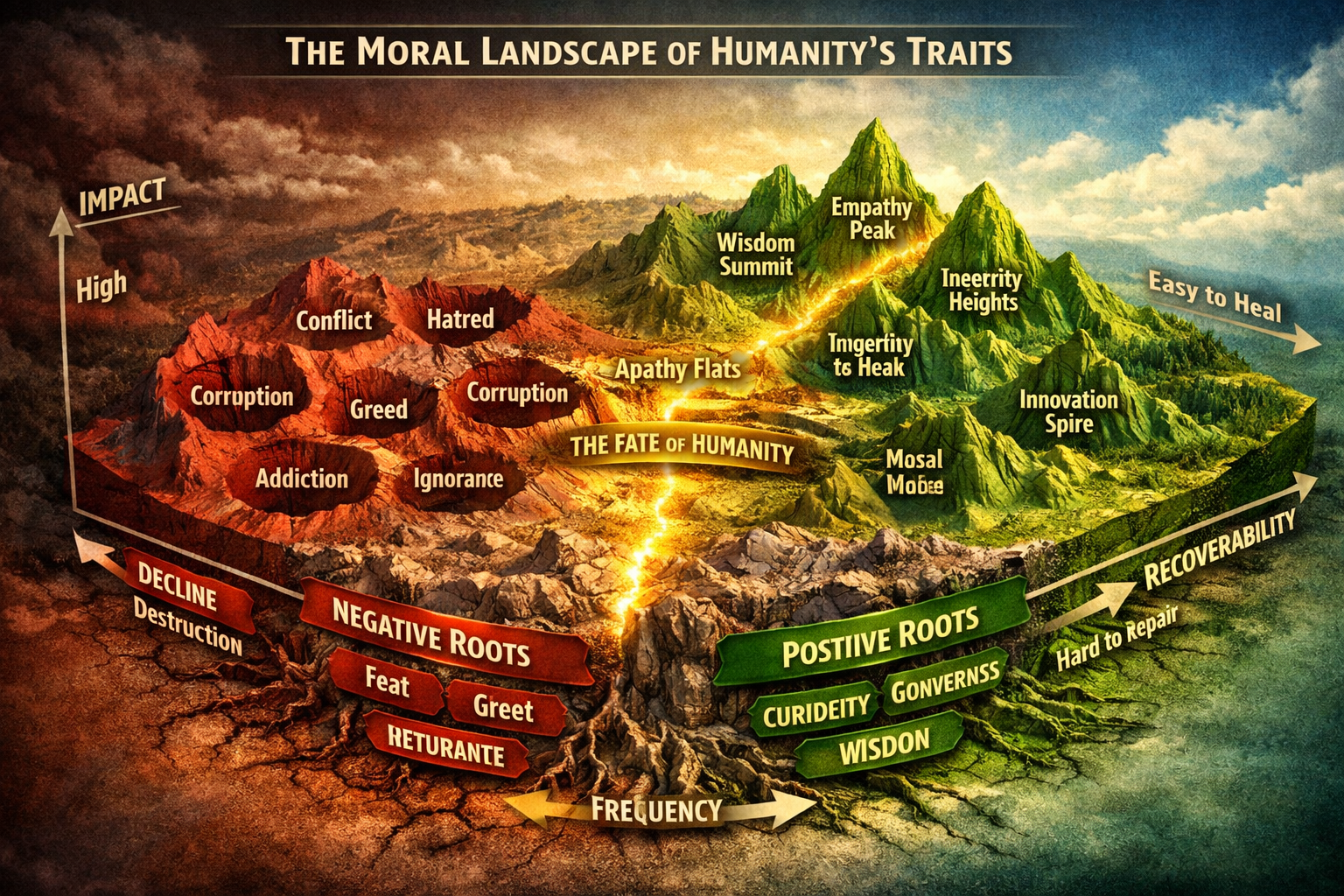
To take stock of humanity is to hold a mirror to ourselves: to name the patterns that wound us and to celebrate the impulses that heal. This page is a small ledger of that reckoning. It weaves together imagery and data drawn from a special treatment of the human condition — categories of harm and virtue, weighted by their impact, their frequency, and our ability to recover from or build upon them.
Read it slowly. Each section is a movement: an image to feel, a table to think, and a few words to bridge the two.
I. The Weighing of Categories
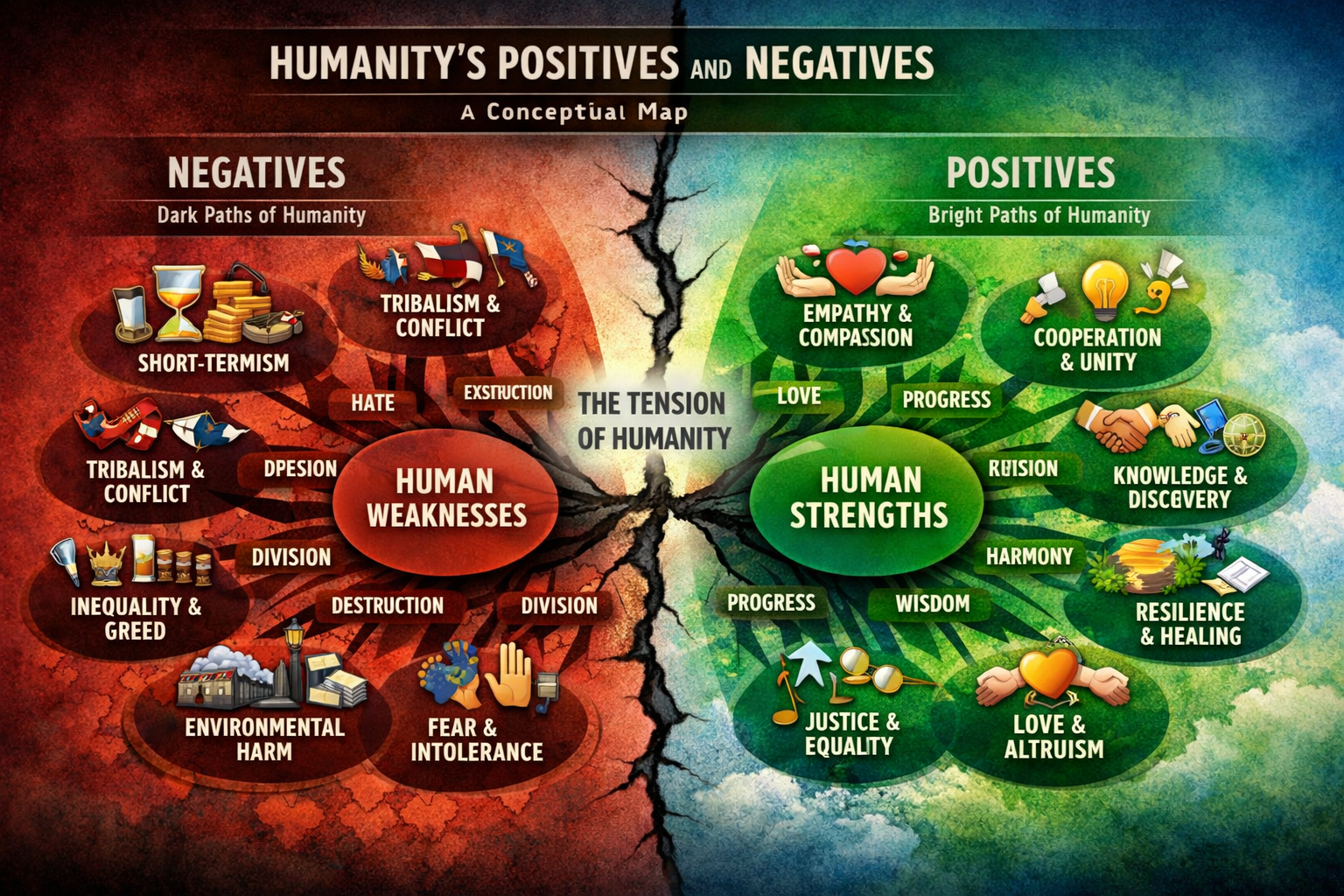
We begin with the broad strokes. Twenty categories — ten shadows and ten lights — each scored across three dimensions: impact (how deeply it shapes lives), frequency (how often it appears), and recoverability (our capacity to repair or extend it). The composite score is the average of these weights.
What emerges is striking: the positives consistently outscore the negatives on recoverability, meaning our virtues are not only present but durable. Knowledge, empathy, creativity, and scientific advancement sit at the very top of the ledger.
| Category | Type | Impact | Frequency | Recoverability | Composite |
|---|---|---|---|---|---|
| Short‑termism | Negative | 9 | 8 | 3 | 6.7 |
| Tribalism & Conflict | Negative | 10 | 7 | 2 | 6.3 |
| Violence & Oppression | Negative | 10 | 6 | 2 | 6.0 |
| Inequality & Greed | Negative | 9 | 8 | 3 | 6.7 |
| Environmental Harm | Negative | 9 | 9 | 4 | 7.3 |
| Ignorance & Misinformation | Negative | 8 | 9 | 5 | 7.3 |
| Fear & Intolerance | Negative | 8 | 8 | 4 | 6.7 |
| Addiction & Excess | Negative | 7 | 8 | 5 | 6.7 |
| Neglect of Mental Health | Negative | 7 | 7 | 6 | 6.7 |
| Failure to Learn from History | Negative | 8 | 7 | 4 | 6.3 |
| Empathy & Compassion | Positive | 9 | 9 | 9 | 9.0 |
| Creativity & Innovation | Positive | 10 | 8 | 9 | 9.0 |
| Cooperation & Unity | Positive | 9 | 8 | 8 | 8.3 |
| Knowledge & Discovery | Positive | 10 | 9 | 9 | 9.3 |
| Resilience & Healing | Positive | 8 | 9 | 9 | 8.7 |
| Love & Altruism | Positive | 9 | 8 | 9 | 8.7 |
| Justice & Equality | Positive | 9 | 7 | 8 | 8.0 |
| Hope & Vision | Positive | 8 | 9 | 9 | 8.7 |
| Moral Progress | Positive | 8 | 7 | 8 | 7.7 |
| Scientific Advancement | Positive | 10 | 8 | 9 | 9.0 |
II. The Shadows We Cast
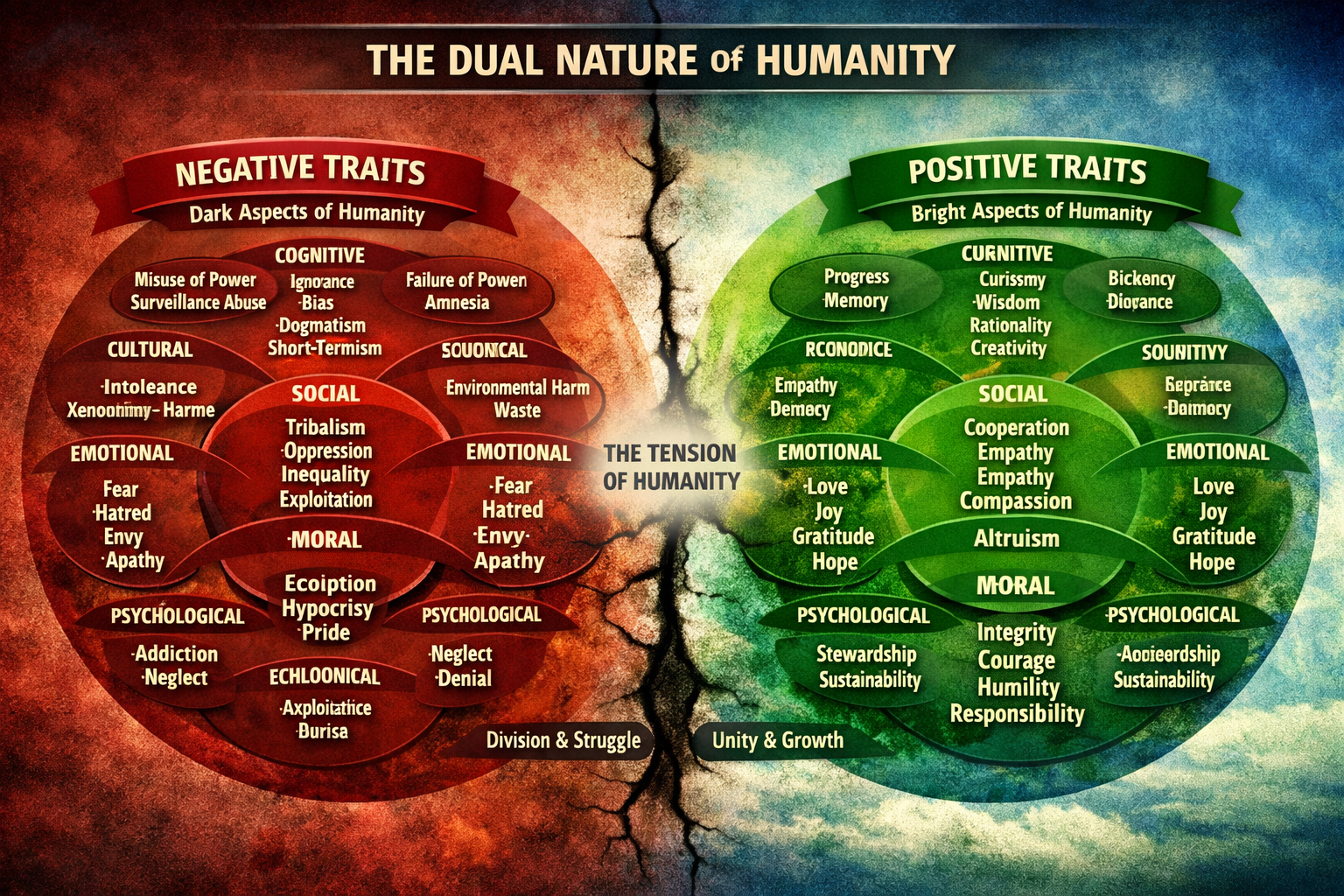
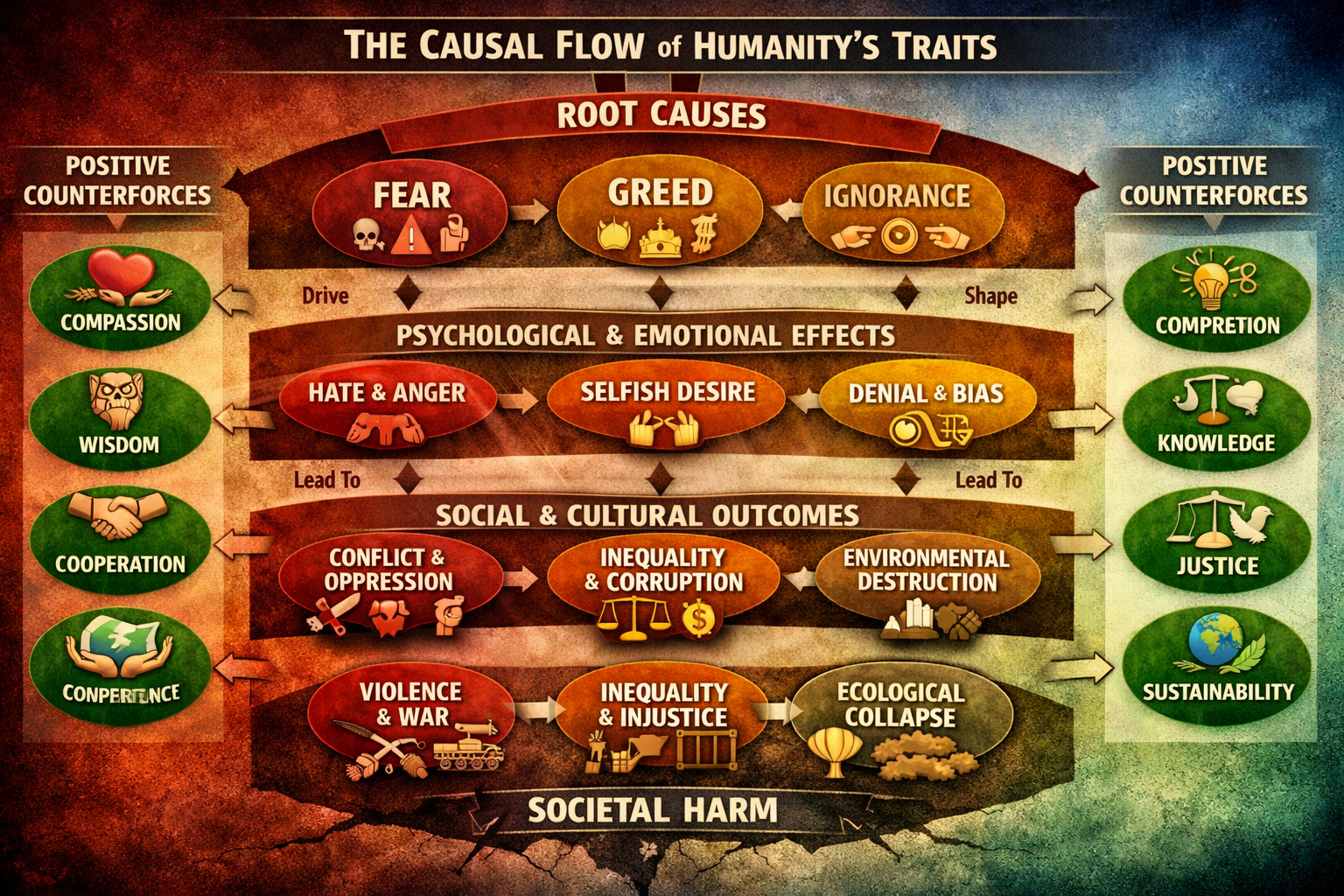
Beneath the broad categories lies a finer anatomy of harm. The shadows of humanity are not isolated failings but interlocking systems: cognitive distortions feed social divisions, which inflame emotional reactions, which corrode moral integrity, which reshape our economies and ecologies. To name them clearly is the first act of repair.
| Domain | Category | Description |
|---|---|---|
| Cognitive | Ignorance | Willful rejection of knowledge or truth. |
| Bias | Distorted reasoning and selective perception. | |
| Dogmatism | Clinging to beliefs despite evidence. | |
| Short‑termism | Prioritizing immediate gain over long‑term stability. | |
| Social | Tribalism | “Us vs. them” identity division. |
| Conflict | Escalation of disputes into violence. | |
| Oppression | Systemic denial of rights or dignity. | |
| Inequality | Concentration of wealth and power. | |
| Exploitation | Using others or nature for selfish ends. | |
| Emotional | Fear | Avoidance of difference and uncertainty. |
| Hatred | Active hostility toward others. | |
| Envy | Resentment of others’ success. | |
| Apathy | Indifference to suffering or injustice. | |
| Moral | Corruption | Betrayal of ethical principles for gain. |
| Hypocrisy | Pretending virtue while acting against it. | |
| Greed | Excessive desire for accumulation. | |
| Pride | Inflated self‑importance and arrogance. | |
| Psychological | Addiction | Compulsive pursuit of pleasure or escape. |
| Denial | Refusal to face reality or responsibility. | |
| Neglect | Failure to care for self or others. | |
| Ecological | Environmental harm | Destruction of ecosystems and biodiversity. |
| Waste | Inefficient use of resources. | |
| Cultural | Intolerance | Rejection of diversity and pluralism. |
| Xenophobia | Fear of outsiders or change. | |
| Dogmatic tradition | Resistance to progress. | |
| Historical | Failure to learn | Repeating mistakes across generations. |
| Amnesia | Forgetting lessons of suffering. | |
| Technological | Misuse of power | Weaponizing innovation. |
| Surveillance abuse | Violating privacy and autonomy. | |
| Economic | Overconsumption | Unsustainable materialism. |
| Exploitative labor | Treating people as disposable. | |
| Existential | Nihilism | Belief that nothing matters. |
| Despair | Loss of hope and meaning. | |
| Alienation | Disconnection from community and purpose. |
III. The Lights We Carry
For every shadow there is an answering light — not as naive optimism, but as evidence. Across the same domains in which we fail, we also rise. Curiosity answers ignorance. Cooperation answers tribalism. Stewardship answers waste. Meaning answers nihilism. These are not abstractions; they are practiced daily, in every community, by ordinary people.
| Domain | Category | Description |
|---|---|---|
| Cognitive | Curiosity | Desire to learn and explore. |
| Wisdom | Integration of knowledge and judgment. | |
| Rationality | Commitment to truth and logic. | |
| Creativity | Generating new ideas and art. | |
| Social | Cooperation | Working together for shared goals. |
| Empathy | Understanding and sharing others’ feelings. | |
| Compassion | Acting to relieve suffering. | |
| Altruism | Helping without expectation of reward. | |
| Justice | Upholding fairness and equality. | |
| Forgiveness | Releasing resentment and restoring peace. | |
| Emotional | Love | Deep connection and care. |
| Joy | Celebration of existence. | |
| Gratitude | Appreciation for life and others. | |
| Hope | Belief in better futures. | |
| Moral | Integrity | Acting consistently with values. |
| Humility | Recognizing limits and learning. | |
| Courage | Facing fear for what’s right. | |
| Responsibility | Owning actions and consequences. | |
| Psychological | Resilience | Recovering from adversity. |
| Self‑awareness | Understanding one’s motives and emotions. | |
| Growth | Continuous improvement and learning. | |
| Ecological | Stewardship | Protecting the planet and life systems. |
| Sustainability | Balancing consumption and renewal. | |
| Cultural | Artistry | Expression through beauty and meaning. |
| Education | Transmission of knowledge and wisdom. | |
| Diversity | Valuing difference and inclusion. | |
| Innovation | Applying creativity to solve problems. | |
| Historical | Progress | Expanding rights and understanding. |
| Memory | Preserving lessons and heritage. | |
| Technological | Discovery | Advancing science and exploration. |
| Communication | Connecting minds across distance. | |
| Accessibility | Making knowledge and tools available to all. | |
| Economic | Generosity | Sharing wealth and opportunity. |
| Fair trade | Ethical exchange and labor. | |
| Existential | Meaning | Creating purpose through values and story. |
| Transcendence | Seeking connection beyond self. | |
| Harmony | Balancing inner and outer worlds. |
IV. The Final Reckoning
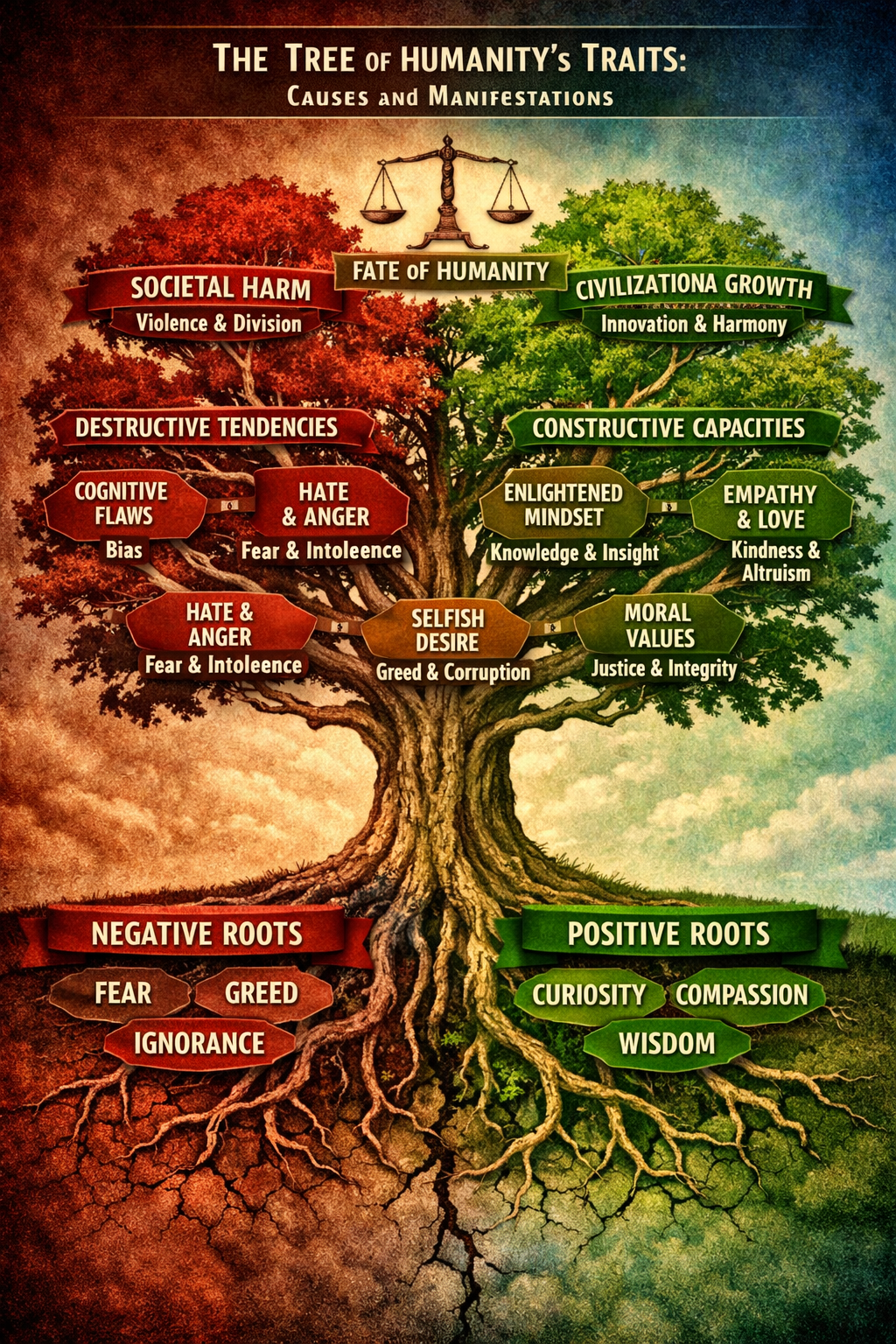
When the categories are summed and weighed — impact multiplied by frequency, lights against shadows — a quiet but remarkable result emerges. Humanity, on the whole, leans positive. Not triumphantly, not without cost, but measurably.
| Metric | Negatives | Positives |
|---|---|---|
| Average Composite Score | 6.7 | 8.7 |
| Weighted Count (Influence × Frequency) | 67 | 87 |
| Balance Index (Positives ÷ Negatives): 1.30 → Humanity leans 30% net positive | ||
Epilogue
If this ledger has a moral, it is simple: we are not condemned by our shadows, nor exempted by our lights. We are the ongoing negotiation between them. The data does not tell us who we must be — it only tells us what we have been, and what we are capable of becoming when we choose curiosity over ignorance, cooperation over conflict, stewardship over waste, and meaning over despair.
The work, as ever, is ours.